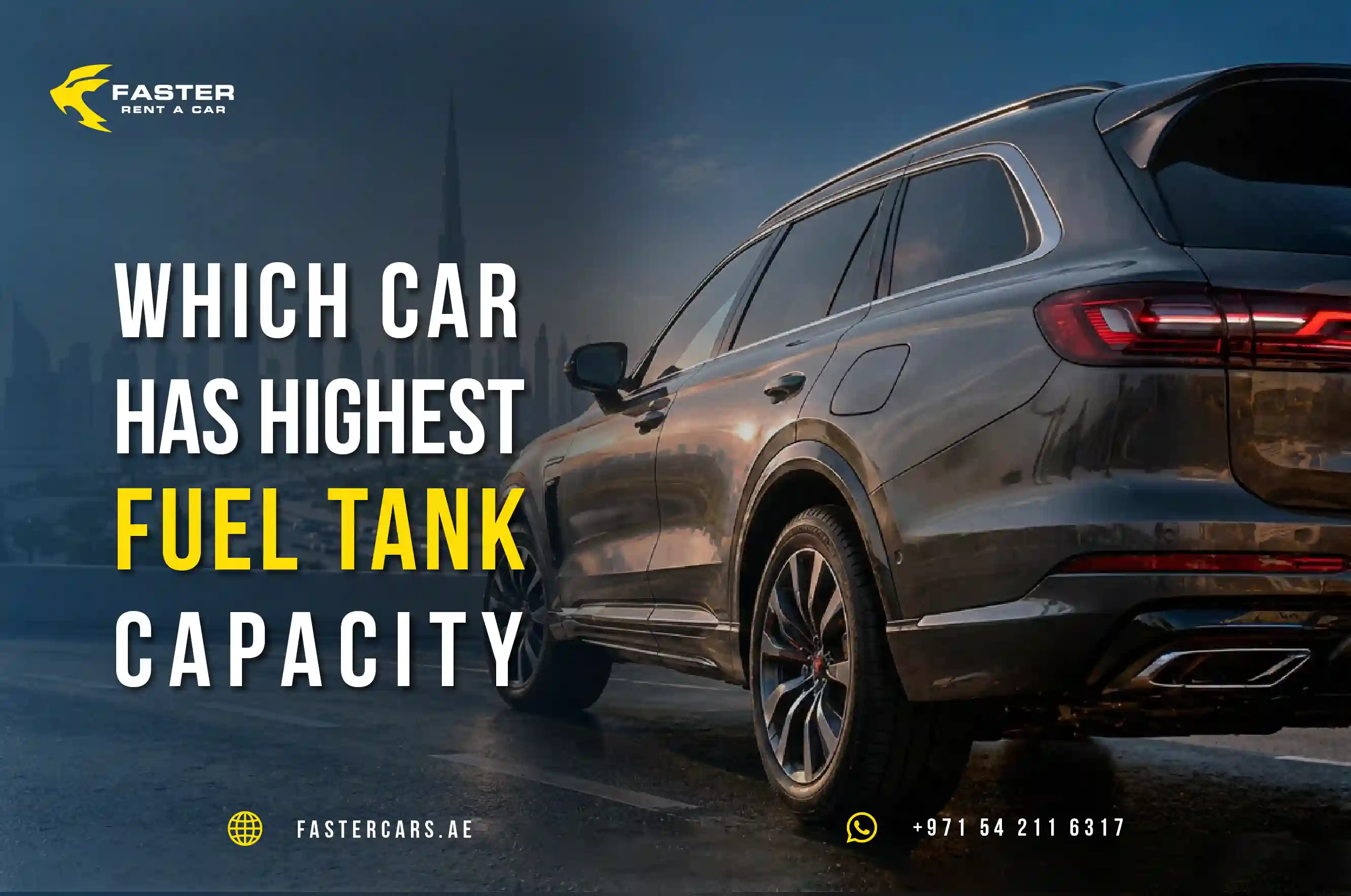
Which Car Has Highest Fuel Tank Capacity? Top Vehicles Compared
The short answer is the 2026 Ram 3500, if heavy-duty pickup trucks and factory-optional tanks count. Ram offers a 50 US gallon tank on Crew Cab models with the 8-foot bed. That equals about 189.3 litres, giving it the largest manufacturer-confirmed capacity in this comparison.
That does not make it the answer in every category. A pickup, an SUV and a passenger car serve different purposes, and their fuel systems are designed accordingly. The Nissan Patrol Safari, for example, carries 135 litres through a 95-litre main tank and a 40-litre subtank. Older grand tourers such as the Ferrari 550 Maranello also had unusually large tanks, but they are discontinued passenger cars, not current trucks or SUVs.
So, which car has highest fuel tank capacity? The honest answer depends on what you mean by “car,” which model year you are comparing, and whether the capacity is standard, optional or split across two factory tanks.
Which Vehicle Has the Biggest Fuel Tank? Quick Answer
Among the road-legal production vehicles checked for this guide, the 2026 Ram 3500 has the largest confirmed factory tank: 50 US gallons, or approximately 189.3 litres. The tank is available only with a specific Crew Cab and 8-foot-bed configuration, so it is not standard on every Ram 3500.
For an SUV, the regional Nissan Patrol Safari is the standout in this comparison. Its total 135-litre capacity combines a 95-litre main tank and a 40-litre subtank. This figure belongs to the Safari generation and must not be applied to the current all-new Patrol.
For a conventional passenger car, the answer is less clear because the biggest examples are generally discontinued luxury or grand-touring models. The Ferrari 550 Maranello is widely documented with a 114-litre tank, but it was produced between 1996 and 2001. Current passenger cars usually hold far less.
| Vehicle and specification | Type | Capacity | Tank arrangement | Status |
| Ram 3500 Crew Cab, 8-foot bed, 2026 | Heavy-duty pickup | 189.3 L / 50.0 US gal | Factory option | Current |
| Ford Super Duty Crew Cab, 8-foot box, 2025 | Heavy-duty pickup | 181.7 L / 48.0 US gal | Factory tank, configuration-specific | Current model generation |
| Chevrolet Silverado HD, 2026 | Heavy-duty pickup | Up to 136.3 L / 36.0 US gal | Configuration-specific factory tank | Current |
| Nissan Patrol Safari Y61 regional specification | SUV | 135.0 L / 35.7 US gal | 95 L main + 40 L subtank | Regional legacy model |
| Ferrari 550 Maranello, 1996 to 2001 | Passenger car / grand tourer | 114.0 L / 30.1 US gal | Standard factory tank | Discontinued |
| Bugatti Veyron 16.4 | Passenger car / supercar | 100.0 L / 26.4 US gal | Standard factory tank | Discontinued |
How We Compared Fuel Tank Capacities
This ranking includes road-legal production vehicles with manufacturer-installed tanks. It excludes aftermarket replacement tanks, tanks mounted in a pickup bed, military vehicles, racing cars and one-off prototypes.
Factory options are included only when clearly labelled. A 50-gallon option and a 50-gallon standard tank are not the same claim. Dual or auxiliary tanks also need to be identified because the quoted total may combine more than one reservoir.
Model year and market matter just as much. A vehicle name can remain in production while its chassis, engine, body style and tank change. Regional specifications can differ too. The 135-litre Nissan figure belongs to the Patrol Safari specification, not every vehicle carrying a Patrol badge.
Finally, published tank capacity is not always the exact amount a driver can add at the pump. Fuel-system design, reserve fuel and filling conditions can create a difference between the nominal figure and a real refill.
Cars and Trucks With the Biggest Fuel Tanks
1. Ram 3500: 50 US gallons (189.3 litres)
The 2026 Ram 3500 takes first place in this comparison. Ram lists an available 50-gallon fuel tank for Crew Cab models paired with the 8-foot bed. This detail matters: shorter beds and other cab configurations can have smaller tanks.
The capacity suits a heavy-duty truck built for towing. Pulling a large trailer increases consumption, so a bigger tank can reduce refuelling stops. It does not make the truck economical.
If someone asks what vehicle has the biggest gas tank, this is the clearest current answer within the eligibility rules used here.
2. Ford Super Duty: 48 US gallons (181.7 litres)
Ford lists a 48-gallon tank on long-wheelbase Super Duty Crew Cab trucks with the 8-foot box. The figure applies to specific gas and diesel configurations, including the F-450 Crew Cab with the 176-inch wheelbase.
Many rankings call the F-450 the winner because they use earlier model years or omit newer Ram configurations. It remains one of the cars with biggest fuel tanks, but the current 50-gallon Ram option is larger.
3. Chevrolet Silverado HD: up to 36 US gallons (136.3 litres)
Chevrolet states that the 2026 Silverado HD range uses tanks between 28 and 36 gallons. The maximum equals about 136.3 litres. Exact capacity depends on configuration, so the model name alone is not enough to identify the tank size.
This is a useful example of why pickup truck gas tank size comparisons often conflict. Regular Cab, Double Cab and Crew Cab trucks may use different beds, wheelbases and fuel systems even when the badge on the tailgate is the same.
4. Nissan Patrol Safari: 135 litres (35.7 US gallons)
The Nissan Patrol Safari has one of the largest verified SUV fuel capacities in this comparison. Nissan’s regional specification lists a 95-litre main tank plus a 40-litre subtank, giving a combined 135 litres.
The distinction between the Safari and the all-new Patrol is essential. They are different generations with different published specifications. Quoting 135 litres for every current Patrol would be inaccurate.
The Safari’s capacity suits Gulf markets, where drivers may cover long distances beyond dense urban areas. Readers comparing options can explore Nissan rental Dubai, but should confirm the exact model before assuming its tank size.
5. Toyota Tundra: 32.2 US gallons (121.9 litres)
The 2026 Toyota Tundra uses a 32.2-gallon tank across the US range, according to Toyota’s model-year information reported by Car and Driver. That is approximately 121.9 litres.
The Tundra sits below the heavy-duty Ram and Ford models because it is a full-size light-duty pickup, not a Class 3 heavy-duty truck. Its capacity is still substantially larger than that of a typical passenger car.
6. Ferrari 550 Maranello: 114 litres (30.1 US gallons)
The Ferrari 550 Maranello is a useful answer to the literal passenger-car question. This front-engine V12 grand tourer is widely specified with a 114-litre tank, or roughly 30.1 US gallons. It was produced from 1996 to 2001, so it is a historical example rather than a current showroom model.
Its large tank supported a powerful engine and long-distance grand-touring role. It also shows why a list that mixes old sports cars with new trucks can confuse readers. Production era and vehicle category belong beside the capacity figure.
7. Bugatti Veyron 16.4: 100 litres (26.4 US gallons)
The Bugatti Veyron 16.4 carries 100 litres, approximately 26.4 US gallons. That is enormous for a two-seat supercar, but still far below the biggest modern heavy-duty pickup tanks.
The Veyron shows why capacity and efficiency are separate. A large tank may be necessary because the engine consumes fuel quickly, not because the vehicle travels farther.
Which Passenger Car Has the Biggest Fuel Tank?
If “car” means a sedan, coupe, wagon or grand tourer, excluding pickups and SUVs, older V12 grand tourers dominate the discussion. The Ferrari 550 Maranello’s documented 114-litre tank is one of the largest well-known passenger-car examples. The Ferrari 456 is commonly listed at 110 litres, while the Bugatti Veyron carries 100 litres.
Calling any one of them the undisputed highest tank capacity car would still need a tightly defined dataset. Manufacturers have produced limited-run cars, market-specific variants and historical models whose technical records are not equally accessible. A reliable answer should therefore state the category, production years and evidence used.
For a current car buyer, these historical numbers are not a realistic benchmark. Many modern petrol passenger cars hold around 40 to 70 litres, depending on their size and design. Large luxury cars may hold more, while compact cars often hold less.
Which SUV Has the Largest Fuel Tank?
Within the manufacturer-confirmed SUV specifications reviewed here, the Nissan Patrol Safari leads with 135 litres. The total comes from two factory reservoirs, a 95-litre main tank and a 40-litre subtank.
That answer requires two qualifications. First, it applies to the Patrol Safari Y61 regional specification. The all-new Patrol uses a different platform and published capacity. Second, a combined main-and-subtank total is not directly identical to a single standard tank, even though both are factory-installed systems.
Large North American SUVs such as the Chevrolet Suburban, GMC Yukon XL and Cadillac Escalade ESV usually sit closer to roughly 28 US gallons, or about 106 to 107 litres, depending on model year and configuration. They offer substantial capacity, but not the Patrol Safari’s 135-litre total.
If passenger space matters as much as fuel capacity, compare the exact model year, seating layout and luggage room. Faster’s verified 7-seater car rental Dubai page is a more useful next step than choosing solely by tank size.
Does a Bigger Fuel Tank Mean a Longer Driving Range?
Not necessarily. Estimated range depends on usable fuel and fuel efficiency:
Estimated range = usable fuel capacity × distance travelled per litre
A 50-litre car returning 15 km/L could theoretically cover 750 km. A 100-litre SUV returning 6 km/L would cover about 600 km under the same simplified calculation. The smaller tank wins because the car uses less fuel per kilometre.
Real range also changes with:
- Vehicle load and trailer weight
- Traffic, speed and driving style
- Engine and drivetrain
- Tyre pressure and road surface
- Air-conditioning use and weather
- Off-road or low-range driving
Use an official fuel-economy rating for planning, then keep a sensible reserve. A calculated maximum should never be treated as a target for running the tank nearly empty.
Why Do Pickups and Large SUVs Have Bigger Fuel Tanks?
Heavy vehicles need more energy to move, especially when towing, hauling or driving away from frequent fuel stops. Their larger chassis also creates more room for a bigger tank.
For a work truck, fewer refuelling stops can reduce downtime. For a large SUV, extra capacity can support long-distance touring, remote travel and the higher consumption of a large engine and four-wheel-drive system. Those advantages come with more fuel weight when the tank is full. Petrol weighs roughly three-quarters of a kilogram per litre, so an extra 50 litres adds around 37 kg of fuel.
A big tank is therefore a capacity feature, not proof of fuel efficiency.
What Is the Average Car Gas Tank Size in Litres?
There is no single official global average because vehicle size, powertrain and market vary. As a practical guide, many petrol passenger cars fall within these broad bands:
| Passenger-car class | Common tank-size range |
| Small city car | About 35 to 45 L |
| Compact or midsize car | About 45 to 60 L |
| Large sedan or grand tourer | About 60 to 90 L |
These are orientation ranges, not specifications. Hybrids may use smaller tanks because they consume less fuel, while performance cars may use larger ones. The correct figure is always the capacity stated for the exact model year and regional version.
Why Fuel Capacity Matters for UAE Road Trips
Tank size can be useful on a long UAE drive, but it should not decide the vehicle by itself. Comfort, tyre condition, luggage space, reliability and suitability for the route matter too.
Before travelling toward remote areas, identify fuel stops, check the route and start with enough fuel. Do not assume a paved-road rental can be taken onto dunes or desert tracks. Rental agreements can restrict off-road and desert use, even when the vehicle has four-wheel drive.
For route planning, see Faster’s Liwa Desert road trip from Dubai guide. Confirm the permitted use of the specific rental vehicle before leaving paved roads.
FAQs
Which car has highest fuel tank capacity?
Among the road-legal production vehicles compared here, the 2026 Ram 3500 leads with an available 50 US gallon tank, approximately 189.3 litres. It applies to Crew Cab models with the 8-foot bed, not every Ram 3500.
What car has the biggest gas tank if trucks and SUVs are excluded?
The Ferrari 550 Maranello is one of the strongest documented passenger-car examples at 114 litres. It is a discontinued grand tourer produced from 1996 to 2001, so the answer for current passenger cars is different.
Which SUV has the largest fuel tank?
The Nissan Patrol Safari regional specification lists a 135-litre combined capacity through a 95-litre main tank and 40-litre subtank. Do not apply that figure to the all-new Patrol.
What pickup truck has the biggest gas tank?
The 2026 Ram 3500 offers a 50-gallon factory tank with the Crew Cab and 8-foot bed. That exceeds the 48-gallon tank available on long-wheelbase Ford Super Duty Crew Cab configurations.
How many litres does an average car fuel tank hold?
Many compact and midsize petrol cars hold roughly 45 to 60 litres. Small city cars can be lower, while large luxury or performance cars can be higher. Check the exact model-year specification rather than relying on an average.
Does a bigger fuel tank give better range?
Only if fuel consumption is comparable. A lighter, more efficient car with a smaller tank can travel farther than a heavy truck with twice the fuel capacity.
Why do tank figures differ for the same vehicle?
Capacity can change with the model year, market, cab, bed length, engine, wheelbase and trim. Some figures refer to an optional tank or combine a main tank with a factory subtank.
Car Rental In Dubai


- Free Delivery
- Insurance Included

Minimum 2 Days Rental✌️

- Free Delivery
- Insurance Included

- Free Delivery
- Insurance Included
Related Blogs

List Of Countries That Accept UAE Driving License
Blog Details
Unique Benefits of SUV Rentals in Dubai That Make Them Better Than Regular Cars
Blog Details
A Comprehensive Guide for Dubai Parking Charges, Zones & Fines
Blog Details
Everything You Should Know About Jaywalking Fine in Dubai
Blog Details
A Detailed Guide for Checking Traffic Fines in Dubai
Blog Details
Top 15 Safe Driving Tips for New Drivers in Dubai
Blog Details.webp)
Bugatti Rental Dubai: Is it Worth Renting the Ultimate Super Sports Car?
Blog Details
How to Choose the Best Luxury Car Rental Company in Dubai
Blog Details
Top 5 Luxury Cars You Should Rent in Dubai
Blog Details
Upcoming Electric Dodge Charger EV - Everything You Need to Know
Blog Details
The Best Christmas Car Rental Offers in Dubai at Faster Rent a Car
Blog Details
What to Drive this Halloween with Faster in Dubai?
Blog Details
The Benefits of Renting a Car with Driver in Dubai
Blog Details
The Benefits of Booking a Rental Car in Advance in Dubai
Blog Details
A Tourist's Guide to Renting a Car and Exploring Dubai
Blog Details
Valentine's Day Car Rental Offers in Dubai
Blog Details
Guide For Roundabout Driving Rules in Dubai
Blog Details
Top 15 Dubai RTA Driving Test Tips
Blog Details
Special Ramadan Car Rental Offers in Dubai, UAE
Blog Details
Step By Step Guide for Checking Driving License Status in UAE
Blog Details
Comprehensive Guide to Visiting Burj Khalifa: Tickets Cost and Tips
Blog Details
The All-New Nissan Patrol 2025 7th Generation Launched in the UAE
Blog Details
Foreign Driving Licenses Accepted for Car Driving in UAE
Blog Details
Comprehensive Guide for Speed Limit in Dubai, UAE
Blog Details
A Detailed Guide to Driving Rules in Dubai, UAE
Blog Details
Lamborghini Introduced Latest Model Temerario, Everything You Need to Know
Blog Details

The Essential Guide to Car Rental Security Deposits
Blog Details
Step By Step Guide on How to Recharge Salik & Pay Online
Blog Details
A Guide to Renting a Car in Different Countries: International Tips and Tricks
Blog Details
Step By Step Guide to Pay Parking in Dubai
Blog Details
List of Best Cars for Desert Safari in Dubai
Blog Details
Discover the UAE's Most Thrilling Roads and Highways: E11, E311, E611 & Beyond
Blog Details
Top 5 Reasons to Be Excited About the BMW Z4 2025
Blog Details
A Closer Look at the Corvette ZR1 2025: Specs, Features, and Design
Blog Details
A Guide for Sharjah Parking Timing and Charges – 2026 Updated
Blog Details
The Importance of Car Rental Insurance
Blog Details
A Complete Guide to Dubai Airport Parking Fees: What You Need to Know
Blog Details
The Best Desert Resorts to Visit with a Rental Car
Blog Details
Understanding Dubai's Traffic Laws and Regulations
Blog Details
A Complete Guide to Using Emirates Vehicle Gate for Vehicle Services in the UAE
Blog Details
Car Rental vs. Leasing Cars in Dubai
Blog Details
Top Convertible Cars for Dubai Marina Drive
Blog Details
Complete Guide to Handle Car Rental Issues and Emergencies in Dubai
Blog Details
A Simple Guide to Car Rental Mileage Policies
Blog Details
Discovering Dubai’s Best Outdoor Adventure Spots by Modified Car
Blog Details
Best Practices for Returning a Rental Car
Blog Details
Should You Rent a Car or Use Taxis in Dubai? A Cost Comparison
Blog Details
How to Obtain a Police Report for Rental Car Accident in Dubai
Blog Details
Car Rental Insurance in Dubai: What's Covered and What Isn't
Blog Details
How Can I Remove Black Points from the License?
Blog Details
Luxury Van Rental for Wedding in Dubai: Complete Guide
Blog Details
Dubai Airport Car Rental Guide for Tourists
Blog Details
How to Plan Corporate Car Rental in Dubai for Events and Exhibitions
Blog Details
Liwa Desert Road Trip from Dubai: Route, Safety and Best Rental Cars
Blog Details
Mercedes AMG vs BRABUS? What is the difference
Blog Details
Camaro vs Mustang: Which Muscle Car to Rent in Dubai?
Blog Details
Pros and Cons of Renting an Electric Car in Dubai
Blog Details
Best Lamborghini Model to Rent in Dubai | Which One Should You Choose?
Blog Details