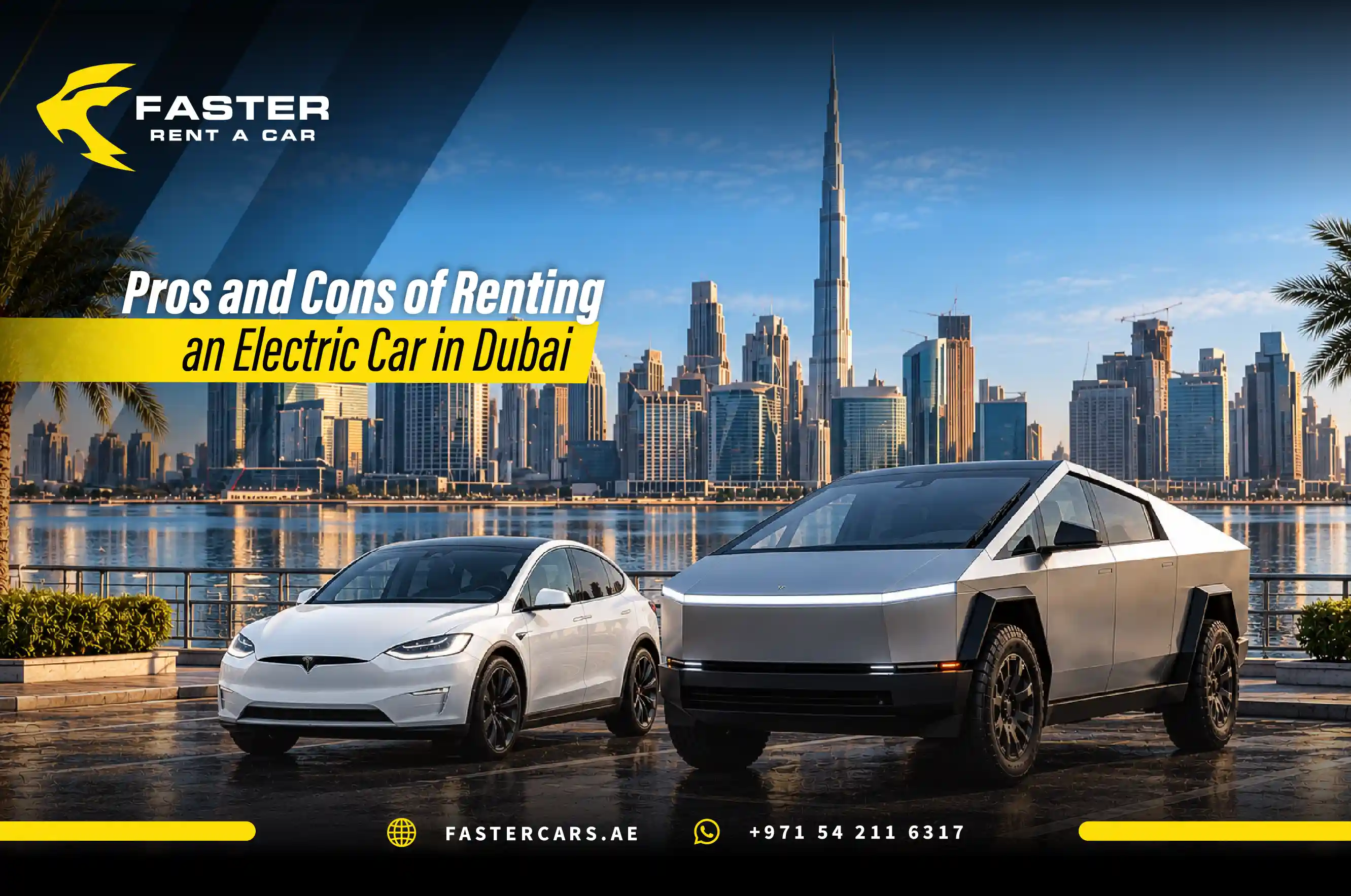
Renting an electric car in Dubai can work well if your trip involves predictable city driving and convenient charging. A hotel charger or a reliable charging stop near your usual destinations can make an EV easy to live with. Frequent long drives, tight schedules and uncertain charging access make the decision less straightforward.
The pros and cons of renting an electric car in Dubai come down to how you will use it. Lower charging costs and quiet driving are appealing, but you also need to consider charging time, summer energy consumption and the battery level required when you return the car.
Before choosing between electric, petrol and hybrid, look at your accommodation, daily routes and total rental cost. Those details will tell you more than an advertised driving range alone.
Advantages of Renting an Electric Car in Dubai
1. Charging Can Lower Your Driving Energy Costs
An electric rental can cost less to power than a petrol alternative, particularly when you have access to lower-priced AC charging. The saving depends on the vehicles being compared, their energy consumption and where you charge.
DEWA lists registered-user tariffs of AED 0.70 per kWh plus VAT for AC charging and AED 1.20 per kWh plus VAT for DC charging. Faster charging therefore has a higher energy price under these tariffs. Source: DEWA EV Charging
For a renter, the useful comparison is the full trip cost. A higher daily rental rate can outweigh the electricity saving, especially during a short stay with little driving. Compare vehicles in a similar class rather than assuming a premium EV will be cheaper overall than an economy petrol car.
2. Quiet, Smooth Driving Suits City Trips
Electric cars deliver power without conventional engine gear changes, which can make urban driving feel smooth. Their lack of engine noise is particularly noticeable at lower speeds, although road, tyre and wind noise remain.
Regenerative braking recovers some energy as the vehicle slows. Depending on the model and settings, lifting off the accelerator can produce stronger deceleration than you expect in a petrol car. Ask for a demonstration during handover. If you are unfamiliar with local roads, review the driving rules in Dubai before your first journey.
For journeys between a hotel, business meetings and attractions around Downtown Dubai or Dubai Marina, these characteristics can be appealing. Take time to learn the controls before leaving, particularly if the car uses a touchscreen for functions you normally operate with buttons.
3. Dubai Has an Established Charging Network
DEWA reported 2,223 charging points across Dubai by the end of Q1 2026, including its network and stations licensed in collaboration with public and private sector partners. This is a dated infrastructure figure, rather than a live count of available chargers. Source: DEWA Q1 2026 results
A charging point also does not necessarily mean a separate location. Several points may be grouped at one site.
For your rental, check compatible charging near your hotel, residence or planned destinations. Confirm access hours and whether charging fits the time you would already spend parked. A convenient charger you can actually use matters more than the citywide total.
4. Tourists Can Use DEWA Guest Mode
International visitors can use DEWA's EV Green Chargers through Guest Mode, without registering for a DEWA EV account. DEWA provides access through the charger QR code and its digital charging service. Source: DEWA charging guidance
This removes one potential obstacle for tourists renting an EV. However, you still need a compatible vehicle, access to the charger and a working payment method.
If the rental company provides a charging card or account, ask whether you should use that arrangement or pay directly. Confirming this before your first charging stop helps you understand who receives the bill and how charges will be settled.
5. You Can Try a Premium EV Without Buying One
A rental gives you time to assess electric driving during a holiday or business visit without committing to ownership. You can find out how the controls, charging routine and cabin layout suit your needs.
Faster Rent a Car's published EV listings include the Tesla Model X and Rolls-Royce Spectre. These offer different vehicle formats, so compare passenger needs, luggage space and the specific car offered for your dates.
Choose the model around your trip rather than its badge alone. A family arriving with several suitcases has different requirements from two people booking a car for a weekend.
6. Battery Electric Cars Produce No Tailpipe Emissions
A fully electric car produces no exhaust emissions while driving. That is a clear distinction from petrol vehicles, particularly during city use.
It does not mean the vehicle has no environmental impact. Electricity production, battery manufacturing and the rest of the vehicle's lifecycle still matter. “Zero tailpipe emissions” is the accurate description.
Also distinguish a battery electric vehicle from a hybrid. A conventional hybrid still uses petrol, while a plug-in hybrid combines a petrol engine with a battery that can be charged externally. Their driving and charging routines differ.
Disadvantages of Renting an Electric Car in Dubai
1. Charging Takes Longer Than Refuelling
Charging requires more time than a typical petrol stop. How much longer depends on the charger, the vehicle's charging capability, battery temperature and the amount of energy you need.
AC charging generally suits longer parked periods, such as overnight stays. DC fast charging is more useful when you need to add energy during a journey. A powerful charger cannot make a car accept electricity faster than the vehicle allows, and charging speed can change during the session. Source: Tesla charging guidance
The practical question is whether charging fits your schedule. Charging while you sleep or attend a meeting can be convenient; making a separate detour between appointments may be frustrating.
2. You Need a Charging Plan
Do not assume that a hotel advertising EV charging has a compatible bay available whenever you arrive. Ask about access, reservations, charging speed, payment and parking arrangements before booking.
A useful plan includes one regular charging location and a backup. If your main charger is occupied or unavailable, you should know where to go next.
Public charging can still suit a tourist itinerary, but consider how long you will actually remain at a destination. A short shopping stop and an overnight hotel stay offer very different charging opportunities. Check the station details instead of relying on a charger symbol on a map.
3. Dubai's Heat Can Affect Usable Range
Hot weather, cabin cooling and battery temperature management can increase energy use. Your real-world driving range can therefore differ from the advertised figure. Speed, driving style and other conditions also affect consumption. Source: Tesla range guidance
There is no single percentage reduction that applies to every EV in a Dubai summer. Plan using the vehicle's route estimate and actual battery level rather than assuming its full advertised range is available.
Keep enough charge for diversions and your next charging stop. Shaded parking can help reduce cabin heat; Tesla also recommends shade to reduce power consumption in hot weather. Follow the instructions for the specific rental vehicle. Source: Tesla hot-weather guidance
4. Inter-Emirate Travel Adds Planning
An EV can suit a Dubai-to-Abu Dhabi journey when the vehicle's usable range and charging options fit the route. Include the return journey, local driving after arrival and any planned detours in your calculation.
If you need to recharge, identify a compatible station and an alternative before leaving. A route estimate that leaves little charge on arrival deserves closer attention, especially when your schedule is fixed.
Repeated long-distance trips may make petrol or a conventional hybrid more convenient. The issue is how much charging coordination you want during the rental, rather than whether electric cars can travel between emirates.
5. Lower Energy Costs Do Not Guarantee a Cheaper Rental
A premium electric car may cost more to rent than a smaller petrol vehicle even if charging costs less than petrol for your driving.
Compare the quoted rental total, expected energy cost and any applicable charging or return charges. Consider parking costs at charging locations where relevant, too.
For a short trip, rental price may dominate the calculation. For a longer stay, convenient regular charging can become more important. Use your expected mileage and the actual quotes to decide. Check the car rental mileage policies as well, because the included distance and any excess-distance charges affect the total cost of either option.
6. Charging and Return Terms Need Checking
The rental agreement should tell you what battery level to expect at delivery and what level is required at return. Do not assume “fully charged” is the rule.
Ask about charging cards, cables, supported networks and how charging expenses are billed. If a return charge can apply, request the calculation in writing.
Include charging in your preparations for returning a rental car. These details affect your last day as much as your first. An early airport departure is easier to plan when you know the return requirement and have checked a suitable charging location beforehand.
Electric vs Petrol Rental Cars in Dubai
| Factor | Electric rental | Petrol rental |
| Replenishing energy | Charging time varies by car, charger and battery level | Refuelling is generally quicker |
| Energy cost | Can be lower, depending on consumption and charging tariff | Depends on fuel price and consumption |
| City driving | Quiet power delivery; regenerative braking may take adjustment | Familiar driving and refuelling routine |
| Accommodation | Convenient charging can simplify the rental | No charging access needed |
| Long-distance flexibility | Requires attention to range and charging stops | Often easier for changing routes and tight schedules |
| Total rental cost | Rental quote and charging terms determine the result | Rental quote and fuel terms determine the result |
| Tailpipe emissions | None for a battery electric car | Exhaust emissions while driving |
A conventional hybrid is another option if you want to avoid external charging. A plug-in hybrid needs a separate comparison because you may use both petrol and charging during the trip.
How Do You Charge a Rental Electric Car in Dubai?
Start with the rental company's instructions for the exact vehicle. Confirm the charging connector, any cable you need to carry and the account or payment method you should use.
1. Find a compatible station. Check DEWA's charger locator or the relevant operator's service. Review location, access and charger details before travelling.
2. Choose charging that fits your stop. AC usually suits longer parked periods; DC is generally more useful when time is limited. Ask the rental company about the vehicle's charging capability.
3. Follow the charger and vehicle instructions. Use the supplied card or account if instructed, or the operator's direct payment process.
4. For DEWA Guest Mode, scan the QR code. Enter your name, email, mobile number and EV plate number, verify your email, select the charging option and complete the payment steps. DEWA says payment is temporarily held and the final charge is based on actual consumption. Source: DEWA Guest Mode process
5. Check that charging has started. Confirm progress on the charger or vehicle display. At the end, stop the session and disconnect as instructed, retain the receipt and check the battery level.
Allow for the return requirement when planning your final charge. You may need energy for the drive between the charger and the agreed handover location.
How Much Does It Cost to Charge an Electric Car in Dubai?
DEWA's published registered-user rates provide a useful cost reference. The table below calculates the energy charge for a session billed at those rates, before VAT or any other applicable costs.
| Charging type | Registered-user rate | Illustrative cost for 50 kWh billed |
| AC | AED 0.70/kWh plus VAT | AED 35 plus VAT |
| DC | AED 1.20/kWh plus VAT | AED 60 plus VAT |
This is an example of 50 kWh billed, not the price of fully charging every electric car. Battery sizes and starting charge levels differ. The energy billed by a charger may also differ from the increase stored in the battery because charging involves losses.
Guest Mode users should check the price and payment conditions shown when starting their session. Do not treat the registered-user calculation as a guaranteed quote for every guest session or charging provider.
For a fair EV-versus-petrol comparison, calculate energy costs for the same driving distance. Then add those costs to each vehicle's rental quote. Charging a battery and filling a petrol tank do not necessarily buy the same number of kilometres.
Who Should Consider Renting an Electric Car in Dubai?
An EV is worth considering if most of your journeys are predictable and you can charge while doing something else. A business traveller with confirmed charging at the hotel, or a tourist staying near a usable charger, may find the routine straightforward.
It can also suit someone who wants to try electric driving or rent a particular premium EV. In that case, convenience and the vehicle experience may matter more than small differences in energy cost.
For family travel, confirm passenger and luggage capacity on the specific vehicle. Battery range is only one part of choosing a useful rental car.
When Might Petrol or Hybrid Be More Convenient?
Consider petrol or a conventional hybrid if you expect frequent long drives, have an unpredictable route or want to minimise time spent coordinating charging.
Accommodation without charging does not rule out an EV. It does mean you need to assess public charging more carefully. If your only practical option requires a separate journey and a wait, that can become an inconvenience over several days.
Your own familiarity matters, too. A short visit with a packed schedule may be easier in a car whose controls and refuelling routine you already know.
Seven Questions to Ask Before Renting an Electric Car
1. What battery percentage will the car have when delivered?
2. What battery level is required when I return it?
3. Which charging networks and connectors can this specific vehicle use?
4. Is a charging card or account supplied, and how is its use billed?
5. Is the necessary charging cable included?
6. Who pays charging costs, and are any service charges added?
7. What charge applies if I return the car below the required battery level?
Get the answers before confirming the booking. This checklist is especially useful if you are comparing quotations that describe charging arrangements differently.
Is an EV Suitable for Your Dubai Itinerary?
| Trip type | Practical assessment |
| City holiday with confirmed hotel charging | A strong option when the car also fits passengers and luggage |
| Business visits around Downtown or Marina | Useful for predictable routes; fit charging around parked periods |
| Premium weekend rental | Choose the vehicle you want, then plan charging and return requirements |
| Dubai-to-Abu Dhabi day trip | Check the complete route, expected battery use and backup charging |
| Multi-emirate road trip | Assess every longer leg and the time available for charging |
| Stay without accommodation charging | Verify a convenient public charger and an alternative before booking |
These are planning recommendations. The exact vehicle, starting battery level and daily schedule determine the result.
FAQs
Do I Need a DEWA Electricity Account to Use Guest Mode?
No. DEWA Guest Mode allows charging without a registered DEWA EV account. Follow the QR-code process and provide the requested contact and vehicle details. If your rental includes a charging account, first confirm which payment arrangement the company expects you to use. Source: DEWA
Can I Pay for DEWA Guest Charging With an International Credit Card?
Yes. DEWA states that international credit cards are accepted under Guest Mode and that payment receipts and invoices are sent by email. Keep the receipt if you need to reconcile charging expenses with the rental company. Source: DEWA charging FAQ
Can I Rely on the Advertised Range for Every Journey?
No. Treat advertised range as a reference, then check the vehicle's route estimate and battery level. Real-world range changes with speed, weather and driving conditions. Include extra driving after arrival and your next charging opportunity when assessing a longer journey. Source: Tesla
Do I Need to Charge to 100% at Every Stop?
Follow the manufacturer's instructions for the specific battery and the rental company's handover requirements. Ask what charge target to use during the trip. A routine charging target and the battery percentage required when returning the rental are separate questions.
Car Rental In Dubai


- Free Delivery
- Insurance Included


Diamond 💎
- Free Delivery
- Insurance Included
Related Blogs

List Of Countries That Accept UAE Driving License
Blog Details
Unique Benefits of SUV Rentals in Dubai That Make Them Better Than Regular Cars
Blog Details
A Comprehensive Guide for Dubai Parking Charges, Zones & Fines
Blog Details
Everything You Should Know About Jaywalking Fine in Dubai
Blog Details
A Detailed Guide for Checking Traffic Fines in Dubai
Blog Details
Top 15 Safe Driving Tips for New Drivers in Dubai
Blog Details.webp)
Bugatti Rental Dubai: Is it Worth Renting the Ultimate Super Sports Car?
Blog Details
How to Choose the Best Luxury Car Rental Company in Dubai
Blog Details
Top 5 Luxury Cars You Should Rent in Dubai
Blog Details
Upcoming Electric Dodge Charger EV - Everything You Need to Know
Blog Details
The Best Christmas Car Rental Offers in Dubai at Faster Rent a Car
Blog Details
What to Drive this Halloween with Faster in Dubai?
Blog Details
The Benefits of Renting a Car with Driver in Dubai
Blog Details
The Benefits of Booking a Rental Car in Advance in Dubai
Blog Details
A Tourist's Guide to Renting a Car and Exploring Dubai
Blog Details
Valentine's Day Car Rental Offers in Dubai
Blog Details
Guide For Roundabout Driving Rules in Dubai
Blog Details
Top 15 Dubai RTA Driving Test Tips
Blog Details
Special Ramadan Car Rental Offers in Dubai, UAE
Blog Details
Step By Step Guide for Checking Driving License Status in UAE
Blog Details
Comprehensive Guide to Visiting Burj Khalifa: Tickets Cost and Tips
Blog Details
The All-New Nissan Patrol 2025 7th Generation Launched in the UAE
Blog Details
Foreign Driving Licenses Accepted for Car Driving in UAE
Blog Details
Comprehensive Guide for Speed Limit in Dubai, UAE
Blog Details
A Detailed Guide to Driving Rules in Dubai, UAE
Blog Details
Lamborghini Introduced Latest Model Temerario, Everything You Need to Know
Blog Details

The Essential Guide to Car Rental Security Deposits
Blog Details
Step By Step Guide on How to Recharge Salik & Pay Online
Blog Details
A Guide to Renting a Car in Different Countries: International Tips and Tricks
Blog Details
Step By Step Guide to Pay Parking in Dubai
Blog Details
List of Best Cars for Desert Safari in Dubai
Blog Details
Discover the UAE's Most Thrilling Roads and Highways: E11, E311, E611 & Beyond
Blog Details
Top 5 Reasons to Be Excited About the BMW Z4 2025
Blog Details
A Closer Look at the Corvette ZR1 2025: Specs, Features, and Design
Blog Details
A Guide for Sharjah Parking Timing and Charges – 2026 Updated
Blog Details
The Importance of Car Rental Insurance
Blog Details
A Complete Guide to Dubai Airport Parking Fees: What You Need to Know
Blog Details
The Best Desert Resorts to Visit with a Rental Car
Blog Details
Understanding Dubai's Traffic Laws and Regulations
Blog Details
A Complete Guide to Using Emirates Vehicle Gate for Vehicle Services in the UAE
Blog Details
Car Rental vs. Leasing Cars in Dubai
Blog Details
Top Convertible Cars for Dubai Marina Drive
Blog Details
Complete Guide to Handle Car Rental Issues and Emergencies in Dubai
Blog Details
A Simple Guide to Car Rental Mileage Policies
Blog Details
Discovering Dubai’s Best Outdoor Adventure Spots by Modified Car
Blog Details
Best Practices for Returning a Rental Car
Blog Details
Should You Rent a Car or Use Taxis in Dubai? A Cost Comparison
Blog Details
How to Obtain a Police Report for Rental Car Accident in Dubai
Blog Details
Car Rental Insurance in Dubai: What's Covered and What Isn't
Blog Details
How Can I Remove Black Points from the License?
Blog Details
Luxury Van Rental for Wedding in Dubai: Complete Guide
Blog Details
Dubai Airport Car Rental Guide for Tourists
Blog Details
How to Plan Corporate Car Rental in Dubai for Events and Exhibitions
Blog Details
Liwa Desert Road Trip from Dubai: Route, Safety and Best Rental Cars
Blog Details
Mercedes AMG vs BRABUS? What is the difference
Blog Details
Which Car Has Highest Fuel Tank Capacity?
Blog Details
Camaro vs Mustang: Which Muscle Car to Rent in Dubai?
Blog Details
Best Lamborghini Model to Rent in Dubai | Which One Should You Choose?
Blog Details